How to Portion Meals for Calories: A Simple Method
How to Portion Meals for Calories: A Simple Method
Portioning a meal for calories means keeping the recipe's proportions and changing only the total amount. The maths takes one division and a handful of multiplications, and once you have done it twice it becomes routine.
The three-step method
- Set a target for this meal. Take your daily calories and split them across the times you actually eat. As an example only, not a recommendation, a 2,000 kcal day could be 450 for breakfast, 600 for lunch, 600 for dinner and 350 for a snack.
- Compute the scale factor. Meal target divided by the recipe's calories per serving.
- Multiply every ingredient by the factor and round to the nearest 5 g, or the nearest gram for small items like sauces.
Because every ingredient moves by the same percentage, the balance of the meal stays the same. The protein moves with it.
Worked example: scaling up
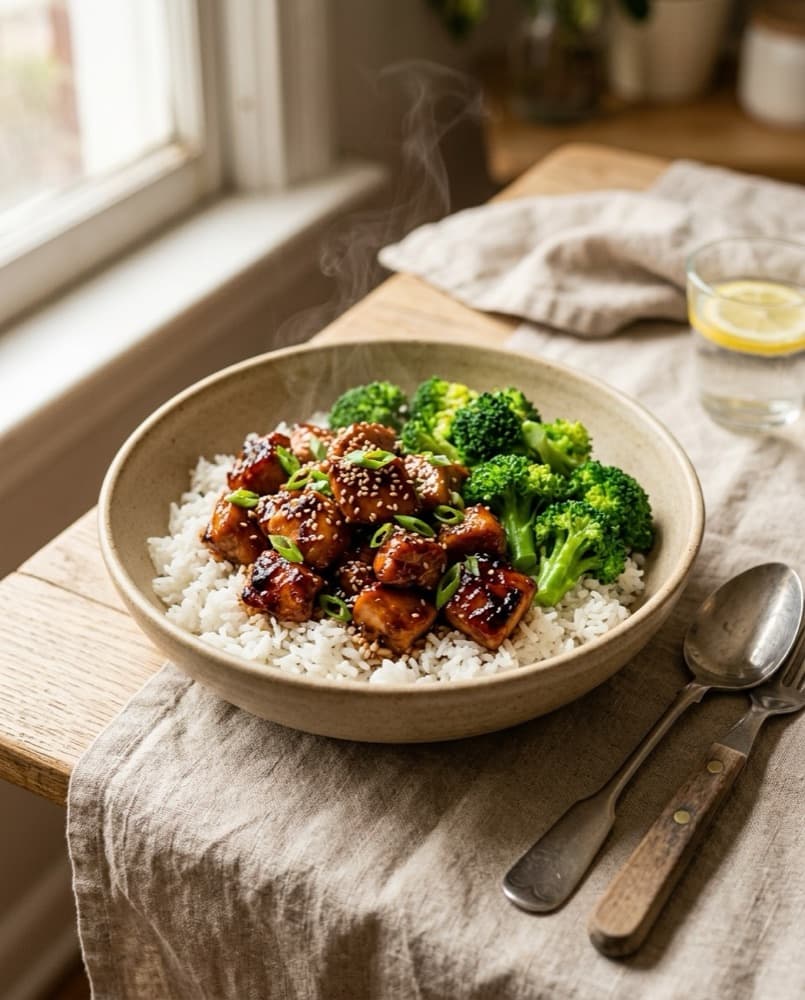
Take the Honey-soy chicken rice bowl: 479 kcal, 51 g protein, €2.68 a serving, 20 minutes. You want a 600 kcal lunch.
Factor: 600 ÷ 479 = 1.25.
- White rice (dry): 55 g becomes 69 g
- Chicken breast: 180 g becomes 225 g
- Broccoli: 120 g becomes 150 g
- Soy sauce: 15 g becomes 19 g
- Honey: 10 g becomes 12.5 g
- Garlic: 3 g becomes about 4 g
Protein: 51 × 1.25 = about 64 g. The cost scales too, to roughly €3.36.
Worked example: scaling down
Same bowl, but this time you have a 400 kcal slot.
Factor: 400 ÷ 479 = 0.84.
- White rice (dry): 46 g
- Chicken breast: 150 g
- Broccoli: 100 g
- Soy sauce: 13 g
- Honey: 8 g
Protein: 51 × 0.84 = about 43 g. Smaller portions carry less protein, so check that your day still adds up.
Two more quick ones
The Crunchy tuna pasta salad has 460 kcal and 51 g of protein. For a 550 kcal lunch the factor is 550 ÷ 460 = 1.2. That gives 72 g dry pasta, 167 g drained tuna, 60 g sweetcorn, 96 g cucumber and 84 g Greek yogurt, with about 61 g of protein.
A pasta dish works the same way. The Lazy mushroom-beef bolognese has 490 kcal, 44 g of protein, €2.83 a serving and takes 20 minutes. For a 600 kcal dinner the factor is 600 ÷ 490 = 1.22, rounded to the nearest 5 g: 75 g dry pasta, 185 g lean ground beef, 185 g passata, 85 g mushrooms and 60 g onion, for about 54 g of protein.
Common mistakes
- Mixing raw and cooked weights. The catalogue lists dry rice and dry pasta, and drained tuna. Cooked rice weighs roughly two to three times as much as dry rice, so weigh before cooking.
- Ignoring the small stuff. A 10 g spoon of honey or a drizzle of oil is a few grams on the scale but not nothing in the total. Weigh them once, then you will know.
- Trimming only one ingredient. If you drop the rice by hand and leave the rest, the totals change and the factor no longer applies. Scale everything evenly, or recalculate.
- Chasing decimals. Rounding to 5 g moves a meal by a handful of calories. Consistency matters more than precision.
Targets also depend on age, body size and activity. If you have a medical condition, are pregnant or have a history of eating disorders, ask a doctor or registered dietitian for a figure before you start. Very low targets are not a good idea without professional guidance.
Skipping the mental maths
The Leanbox portion calculator does exactly this. Set a portion with the slider or type a calorie target, and every ingredient is rescaled in grams, along with the calories and macros. You can try it in the Leanbox app, which is coming soon to the App Store. And if you want to sanity-check the protein side of your day, read how much protein you need to lose fat.
FAQ
How do I calculate a portion size for a calorie target?
Divide your target by the recipe's calories per serving, then multiply every ingredient weight by the result. For example, 600 divided by 479 is about 1.25, so 180 g of chicken becomes about 225 g.
Should I weigh food raw or cooked?
Weigh it the way the recipe lists it, such as dry rice, dry pasta, raw meat and drained tuna. Mixing raw and cooked weights is the most common reason a meal ends up far from its calorie figure.
How many calories should one meal have?
It depends on your daily target and how many times you eat. A simple approach is to split the daily total across your meals and snacks, for example 450, 600, 600 and 350 kcal for a 2,000 kcal day.
Does protein change when I scale a recipe?
Yes, it scales by the same factor. The honey-soy chicken rice bowl has 51 g of protein at 479 kcal, about 64 g at 600 kcal and about 43 g at 400 kcal.